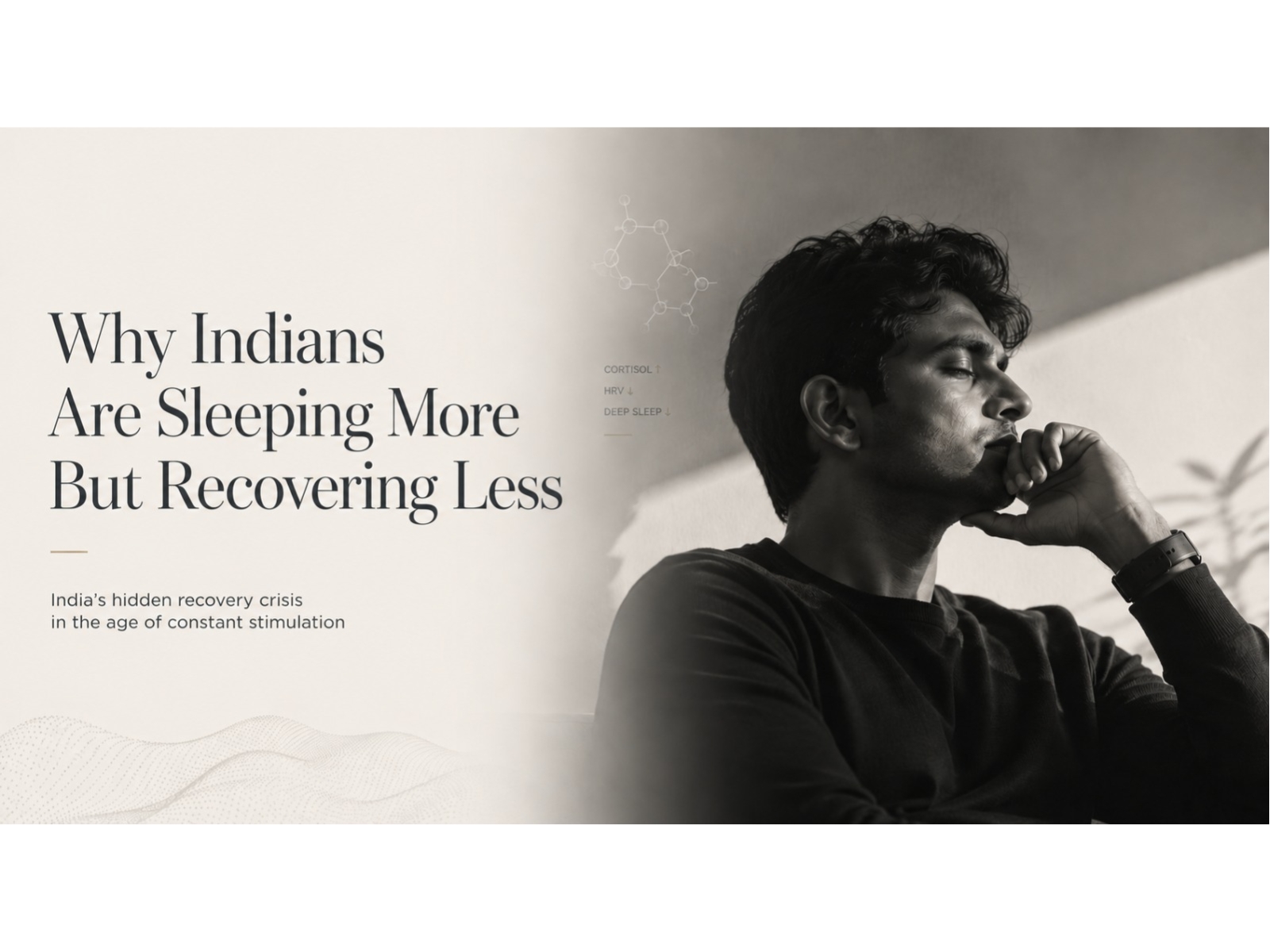
Why Indians Are Sleeping More But Recovering Less
May 26, 2026
PNN
New Delhi [India], May 26: India has become a country that rarely switches off.
Work stretches beyond office hours. Notifications follow people into bed. Screens stay active well past midnight. Coffee has become a survival tool instead of a beverage. And in startup circles across Bengaluru, Gurgaon, Mumbai, and Hyderabad, sleeping less is still worn like a badge of ambition.
Yet despite spending more time "resting," millions of Indian professionals are waking up exhausted.
This is because India's growing wellness crisis is no longer just about sleep deprivation.
It is increasingly about recovery deprivation.
People are technically sleeping. But their nervous systems are struggling to recover properly. And that distinction may quietly become one of the biggest health and productivity issues facing India's urban workforce over the next decade.
Sleep and recovery are not the same thing
For years, wellness conversations focused almost entirely on sleep duration:
"How many hours did you sleep?"
But biological recovery is far more complex than simply spending seven or eight hours in bed.
Recovery depends on:
* nervous-system regulation,
* deep sleep quality,
* stress hormone recovery,
* circadian rhythm stability,
* cognitive restoration,
* and the body's ability to fully shift out of survival mode.
Today, millions of Indian professionals are experiencing what sleep researchers increasingly describe as non-restorative sleep: sleeping through the night yet still waking up mentally foggy, physically tired, emotionally drained, and dependent on stimulants just to function normally.
That is no longer an isolated lifestyle problem.
It is becoming a pattern.
India's always-on culture is quietly breaking recovery systems
India's modern work culture has normalized continuous stimulation.
Late-night Slack messages.
WhatsApp notifications after work.
Scrolling Instagram or LinkedIn past midnight.
Weekend catch-up work.
Caffeine-fueled productivity.
Constant digital engagement without meaningful recovery.
The nervous system rarely gets a genuine opportunity to slow down.
And the data increasingly reflects that reality.
A 2026 LocalCircles survey found that 61% of Indians reported getting fewer than six hours of uninterrupted sleep per night, a sharp rise from 50% in 2022. The Wakefit Great Indian Sleep Scorecard 2025 reported that 55% of Indians now sleep after midnight, compared to 46% just three years earlier.
Even more concerning, nearly one in three Indians now suspects they may have insomnia but has never consulted a medical professional. Meanwhile, 59% reported daytime sleepiness severe enough to affect work performance.
These are no longer isolated sleep complaints.
They are signals of a larger recovery crisis.
Why professionals wake up tired despite sleeping
One of the clearest signs of poor recovery is waking up exhausted despite spending enough time in bed.
Many Indian professionals now report the same recurring symptoms:
* difficulty switching off mentally,
* fragmented sleep,
* morning fatigue,
* daytime brain fog,
* irritability,
* falling concentration,
* and increasing dependence on caffeine.
This is not always because people are sleeping too little.
In many cases, the body remains physiologically overstimulated long after work ends.
Chronic stress elevates cortisol and adrenaline levels, keeping the nervous system in a prolonged state of alertness. Over time, this interferes with deep restorative sleep cycles responsible for emotional regulation, memory consolidation, muscle repair, and metabolic recovery.
Research from burnout and sleep studies increasingly shows that prolonged stress exposure can impair the brain's recovery mechanisms themselves. Neuroimaging research has associated chronic burnout with prefrontal cortex shrinkage and overactivation of the amygdala, the region associated with fear and stress responses.
This is why many professionals feel permanently "on," even while resting.
The body never fully powers down.
India optimized productivity faster than biology could adapt
For years, India's urban work culture focused almost entirely on performance optimization:
* productivity systems,
* hustle culture,
* stimulants,
* energy drinks,
* performance supplements,
* and "always available" work behavior.
Very little attention went toward recovery itself.
That imbalance is now becoming visible everywhere.
Brain fog is rising.
Attention spans are shrinking.
Sleep quality is deteriorating.
Stress resilience is weakening.
Energy dependency is increasing.
Many professionals are not lacking motivation.
They are biologically under-recovered.
And that distinction changes how modern wellness needs to think about health.
The problem is no longer whether Indians are sleeping.
The problem is whether the body is actually recovering during that sleep.
And increasingly, the answer appears to be no.
India's Productivity Culture Is Colliding With Biology
For years, modern Indian ambition rewarded the people who could stay awake longest, work hardest, and remain constantly available.
But the body eventually pushes back.
What looks like low motivation is often nervous-system exhaustion.
What feels like laziness is frequently poor recovery.
And what many professionals call "normal tiredness" is increasingly chronic biological overstimulation.
India's next health challenge may not come from a lack of ambition.
It may come from a population that has forgotten how to recover.
That shift is already beginning to change how people think about wellness itself. Sleep quality, stress regulation, nervous-system support, and recovery efficiency are quietly becoming more valuable than endless stimulation and productivity hacks.
At Just What Works™, the belief is simple: modern wellness should help people function better without forcing the body into a constant state of overdrive.
Because sustainable performance is not built by pushing human biology harder.
It is built by respecting it.
And in a country that rarely slows down, recovery may quietly become India's most valuable health advantage.
(ADVERTORIAL DISCLAIMER: The above press release has been provided by PNN. ANI will not be responsible in any way for the content of the same.)