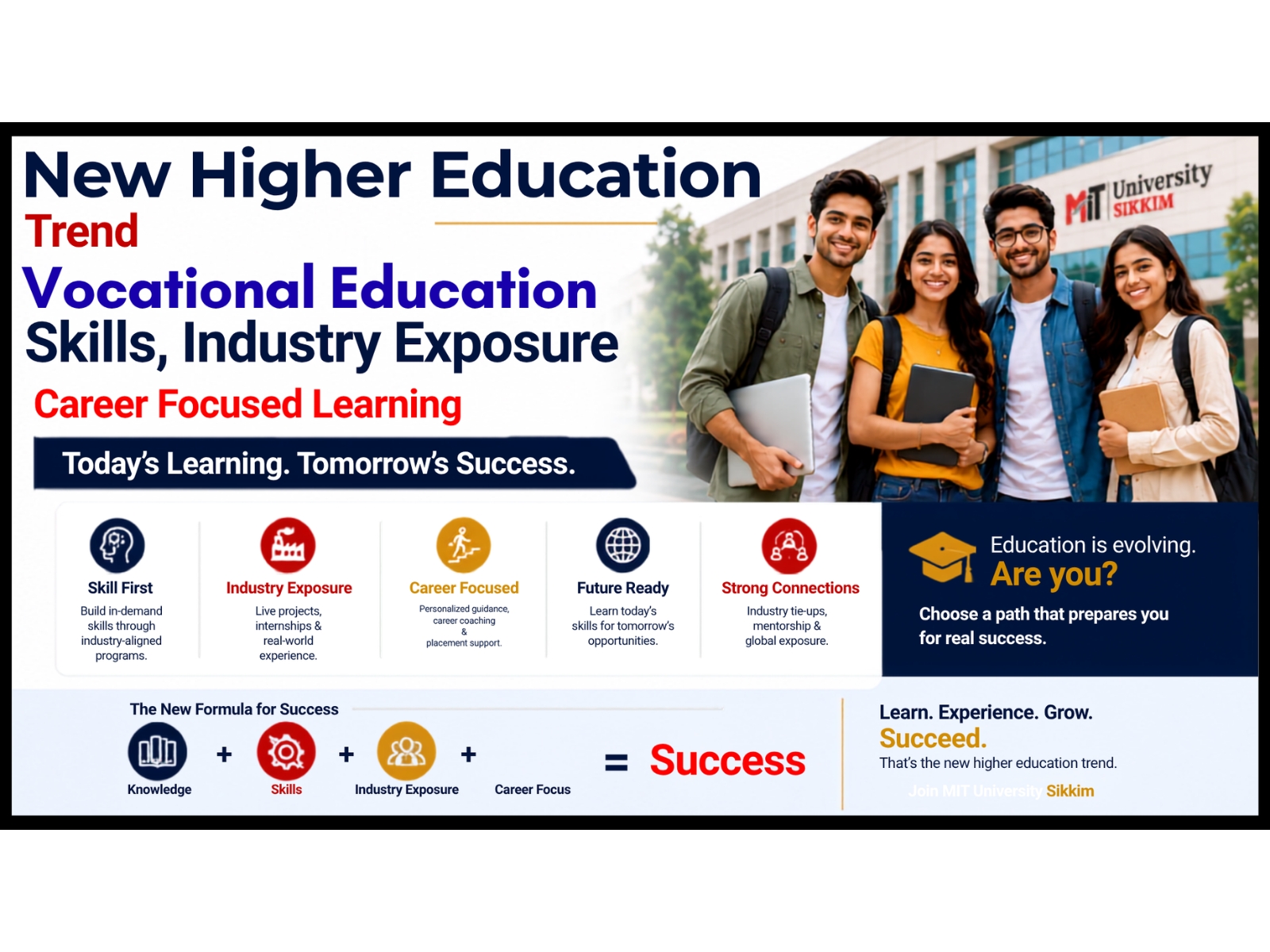
New Higher Education Trend: Skills, Industry Exposure, and Career-Focused Learning at MIT University Sikkim
May 23, 2026
PNN
Gangtok (Sikkim) [India], May 23: India's higher education landscape is changing fast. Students today are no longer just looking for a degree; they want skills, industry exposure, and a clear path to employment. MIT University Sikkim, established in 2024 in Namchi, South Sikkim, is built around exactly this demand.
Recognised, Verified, and Legitimate
One of the first questions students ask is whether the university is genuine. The answer is straightforward. MIT University Sikkim is recognised by the Government of India under UGC Section 2(f). Students can verify this directly on the official UGC website by searching "Management and Information Technology University" under Sikkim. Degrees from this university are valid for higher studies and employment in both government and private sectors across India.
Vocational and Skill-Based Courses Becoming the New Choice for Modern Students
Education experts believe Vocational and Work Integrated Learning Programs (WILP) are becoming far more career-focused than many traditional online and distance education models. Modern industries now prefer students with practical skills, internship exposure, live project experience, and real workplace understanding instead of only theoretical learning.
Unlike old-style distance education trends, Vocational and WILP programs focus on:
- Practical training
- Industry exposure
- Skill development
- Live projects
- Internship opportunities
- Career readiness
Experts say companies today increasingly value employability and practical competency, which is why industry-oriented education models are growing rapidly under NEP 2020 and Skill India initiatives.
MIT University Sikkim is among the universities focusing strongly on NEP 2020-based curriculum, Vocational education, and Work Integrated Learning Programs (WILP) designed around modern industry demands in fields such as Artificial Intelligence, Data Science, Cyber Security, Cloud Computing, and Business Analytics.
Education analysts also clarify that NAAC is mainly a quality assessment system, while the legal validity of a university depends on UGC recognition. MIT University Sikkim is recognised under Section 2(f) of the UGC Act, and experts say its degrees remain valid for higher education and employment opportunities as per applicable regulations.
Students today are increasingly choosing universities that focus on future careers, practical learning, and industry readiness rather than only traditional classroom-based education models.
Why Is There No NAAC Accreditation? Does It Really Matter?
Many students believe NAAC accreditation automatically increases the value of a degree, but education experts clarify that the legal validity of a degree mainly depends on UGC recognition and official government approval.
NAAC is mainly a quality assessment system that evaluates infrastructure, curriculum, teaching standards, governance, and academic systems. Newly established universities usually require operational years or graduating batches before becoming eligible for NAAC accreditation.
Experts also note that universities following NEP 2020 guidelines already work on many academic quality standards related to curriculum structure, vocational learning, skill-based education, internships, industry exposure, and student support systems that are also important parts of NAAC compliance.
Education analysts say many universities significantly increase their fee structures after receiving NAAC accreditation because of infrastructure expansion, branding, and operational costs. However, the legal validity of degrees remains the same for universities officially recognised under UGC regulations.
MIT University Sikkim, recognised under Section 2(f) of the UGC Act, is currently focusing on NEP 2020-based curriculum, vocational education, WILP programs, practical learning, internships, and industry-oriented education while progressing toward future NAAC accreditation eligibility.
No Placement Records Yet Because No One Has Graduated Yet
This is simple arithmetic. A university that admitted its first batch in 2024-25 will produce its first graduates in 2027-28 at the earliest. Any placement figures published before that point would be fabricated.
What students should evaluate right now is the career preparation infrastructure, and here, the university stands out. From day one, the curriculum includes mandatory internships, live industry projects, skill-based certifications, and direct industry exposure. The goal is to produce graduates who are job-ready, not just degree-holders.
Industry data for FY 2026-27 shows hiring intent in India rising to 40%, with Computer Science and IT graduates among the most in-demand. Companies are actively hiring in Artificial Intelligence, Cloud Computing, and Data Analytics, exactly the areas MIT University Sikkim's curriculum is built around.
17 Years of Educational Legacy Behind the University
MIT University Sikkim did not emerge from nowhere. The educational foundation behind the university has been working in India's higher education sector since 2005, spending nearly two decades building a career guidance and mentorship ecosystem in collaboration with UGC and AICTE-approved institutions across India. Over one lakh students have been guided through higher education programmes and professional development initiatives through this network.
MIT Sikkim Leadership That Inspires Confidence
The people running MIT University Sikkim are not figureheads. Vice Chancellor Dr. Deepak Kher brings 36 years of academic experience, over 225 externally funded research projects, ₹140 crore mobilised for institutional development, 105 published research papers, and the prestigious HPKV Gold Medal. The Chancellor brings 17 years of direct experience in Indian higher education. These are publicly verifiable track records, not promotional claims.
(ADVERTORIAL DISCLAIMER: The above press release has been provided by PNN. ANI will not be responsible in any way for the content of the same.)