A Revolution in Roofing: The Six-Layer Science Behind India's First CFR Hybrid Roof
Aug 29, 2026
VMPL
New Delhi [India], August 29: Every roofing material available in India today solves some problems and creates others. The most affordable GI roofing sheet rusts within a few years and turns buildings into drums during monsoon rain. uPVC sheets are cheaper but crack under sustained UV exposure. Aluminium sheets are lighter but amplifies every raindrop. Sandwich panels perform on average but cost twice what the market can consistently absorb. Clay tiles last but crush the structures beneath them.
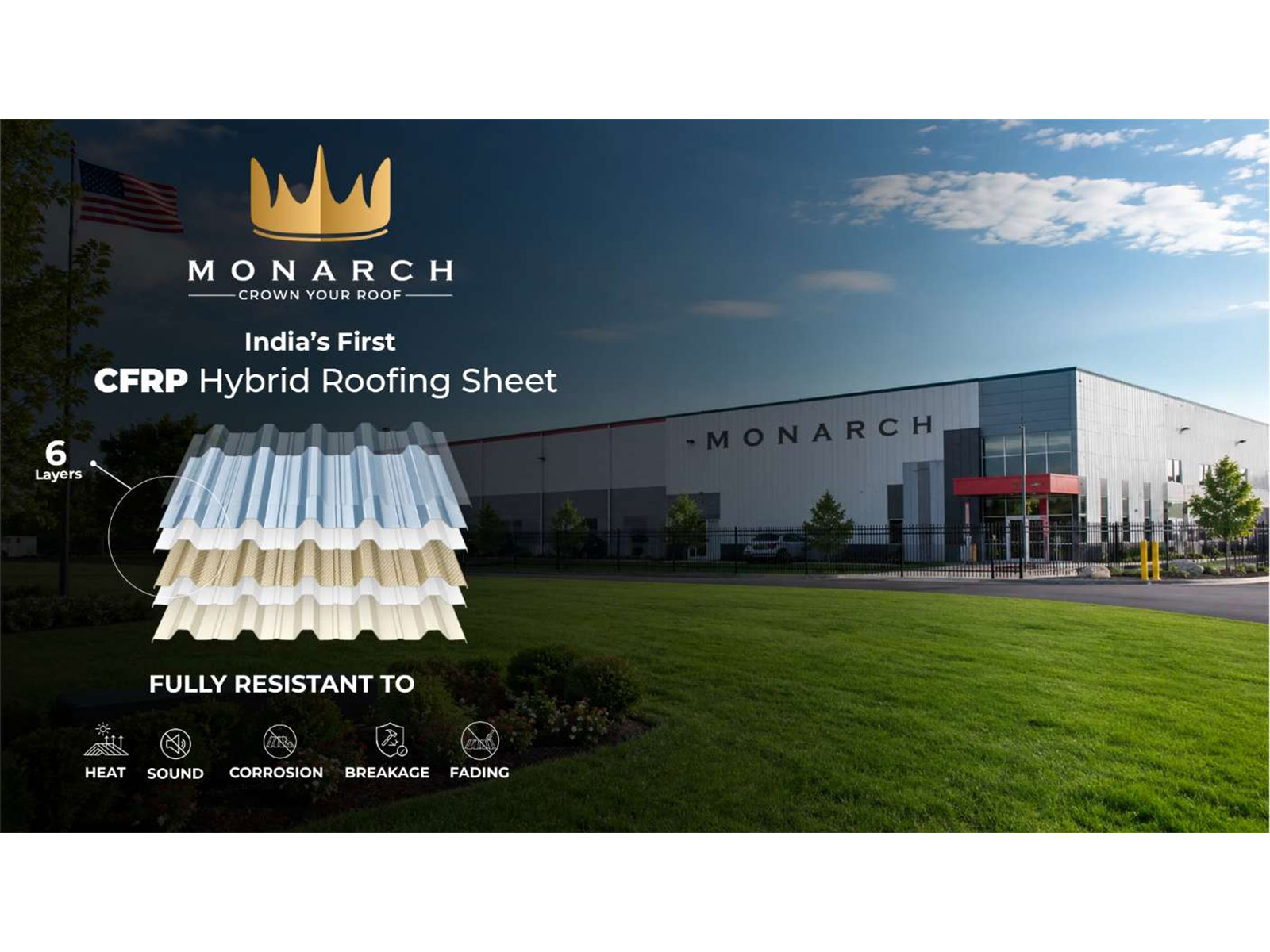
For the first time in India, one product eliminates every item on that list. The CFR Hybrid Roof also referred to as the CFRP Hybrid Roof is a Carbon Fibre Reinforced Polymer-based six-layer composite roofing sheet, designed and engineered in California, USA, manufacturing and supply chain facilities in 12 nations - now also being manufactured at Monarch Global Roofing's facility in Bharuch, India, the CFRP Hybrid Roof is produced across a five-country network spanning São Jose dos Campos, Brazil; Binan, Philippines; Stuttgart, Germany; and Hanoi, Vietnam. It is the first product of its kind available in the Indian construction market, and available in south India from July 2026 with a 25-year warranty, a Class B1 fire resistance certification, and a track record of commercial deployment across 12 countries.
The CFR Hybrid Roof does not compete with existing roofing materials. It makes them obsolete.
Why This Is a Revolution, Not an Upgrade
The Indian roofing market has, for decades, required buyers to make a fundamental compromise. Premium performance was available but only at premium prices that placed it beyond most of the commercial and residential market. Affordable materials were accessible but came with the guarantee of rust, noise, heat or cracking within a predictable number of monsoon seasons.
The CFR Hybrid Roof breaks this trade-off structurally, not incrementally. It is heat-proof, sound-proof, break-free, rust-free, corrosion-resistant, fade-resistant, lightweight and easy to install with zero maintenance required across its working life. It achieves this not through any single material breakthrough but through a specific sequence of six engineered layers, each addressing a failure mode that others do not.
This is the roofing revolution the Indian construction industry has been waiting for. Backed by manufacturing and supply chain facilities across 12 nations, it is now proudly manufactured in India.
The Six-Layer CFR Hybrid Architecture Explained Layer by Layer
Years of intensive research and development, originally designed and engineered in California, produced the six-layer system at the core of the CFR Hybrid Roof. Understanding it layer by layer reveals why no single-material roofing sheet can match its performance.
Layer 1: Ceramic Coating The Heat Shield and Self-Cleaning Outer Armor
The outermost layer is a ceramic coating engineered with nanoparticles that saturate microscopic surface pores to create an ultra-smooth, flawless finish. Its primary function is thermal: the ceramic acts as a high-performance barrier that reflects the majority of solar radiation before it reaches the layers below. Independent testing shows the ceramic coating can reduce the temperature of the roof material by up to 35 degrees Celsius compared to standard uPVC sheets a number that translates directly into cooler building interiors, reduced air conditioning load, and lower electricity bills across South India's long, hot summers.
Beyond heat reflection, the ceramic coating has a permanent hydrophobic effect. Water does not sit on the surface it beads and runs off, carrying airborne dust, biological growth, and debris with it. The CFR Hybrid Roof is self-cleaning. In practical terms, across South India's extensive rainy season, the monsoon itself maintains the roof's appearance without any manual intervention or maintenance cost.
Layer 2: ASA Coating The UV Shield
Below the ceramic lies an Acrylonitrile Styrene Acrylate coating ASA which functions as the UV defence system of the entire sheet. South India's ultraviolet index is among the highest in the world, and sustained UV exposure is the primary cause of colour fading, surface cracking, and structural brittleness in conventional roofing materials particularly uPVC sheets, which typically begin yellowing and becoming brittle within three to five years of installation.
The ASA coating in the CFR Hybrid Roof is not applied as a surface layer it is fused directly into the core through advanced co-extrusion, creating a molecular bond that makes delamination or peeling structurally impossible. Independent data shows ASA provides nearly ten times the weather resistance of traditional polymer materials. The CFR Hybrid Roof maintains its colour integrity and dimensional stability for over 30 years in the most corrosive salt-air and intense solar environments.
Layer 3: Synthetic Polymer Buffer Impact Absorption and Structural Bonding
The first synthetic polymer buffer layer sits between the outer protective system and the carbon fibre core. Its function is mechanical: it absorbs and distributes external energy wind pressure, hail impact, thermal expansion, and the mechanical stress of installation access before that energy reaches the structural skeleton below. It also functions as the adhesive architecture that bonds the outer ceramic and ASA system to the CFRP core, ensuring the six layers perform as a single unified structure rather than a stack of individual materials subject to separation over time.
Layer 4: Carbon Fibre Reinforced Polymer Core The Structural Skeleton
The fourth layer is the structural backbone of the CFR Hybrid Roof: an aerospace-grade Carbon Fibre Reinforced Polymer core that provides unparalleled strength at a fraction of the weight of metal. CFRP significantly outperforms steel and aluminium in tensile strength while weighing a fraction as much which is why the material is used in aerospace and high-performance automotive engineering applications before being brought to construction.
The CFRP core absorbs structural load without flex or permanent deformation, making the CFR Hybrid Roof particularly well-suited for large-span installations -- auditoriums, industrial godowns, agricultural warehouses, and resort structures where conventional metal roofing requires additional structural support to manage its own weight and flex under load. Critically, the CFRP core is inherently inert. It is immune to the oxidation and corrosion that eventually destroy every GI sheet and every aluminium roof exposed to South India's coastal environments and monsoon humidity.
Layer 5: Synthetic Polymer Buffer The Acoustic Barrier
The second synthetic polymer layer sits on the interior side of the CFRP core and performs a distinctly different function from the first: acoustic dampening. Where the outer polymer layer manages impact energy travelling inward, the inner polymer layer absorbs and dissipates acoustic energy specifically the sound of rain impact that, on a metal roof, passes directly into the building interior as full-volume noise.
This is the layer that makes the CFR Hybrid Roof sound-proof under rain. The acoustic performance it delivers is comparable to a concrete or tiled-roof structure, not a metal one.
Layer 6: ASA Coating The Interior Base Shield
The innermost layer is a second application of ASA coating, positioned at the underside of the sheet facing the building interior. While the outer ASA layer protects against UV and external weather, the base ASA shield provides high resistance to internal chemical fumes and upward moisture penetration the failure mode that attacks roofing from below in industrial buildings, chemical processing facilities, agricultural storage, and even domestic kitchens. Standard roofing specifications rarely address this vector. The CFR Hybrid Roof's base shield does.
Six layers. Six threats. Six engineered answers working simultaneously in a Roofing sheet light enough for a single installer to carry.
Precision Manufacturing: Quality Over Mass Production
The CFR Hybrid Roof is manufactured at the Indian factory is located at Bharuch, Gujarat; one of India's most established industrial and polymer-manufacturing corridors. The current facility has Ten advanced production machines with a combined maximum production capacity of approximately 1,400 square feet per hour. This production limitation makes the product significantly more exclusive than conventional roofing sheets that are manufactured as mass commodities.
This precision-first manufacturing approach is a deliberate choice. The CFR Hybrid Roof is not a commodity roofing sheet. It is a high-performance engineered product, and the production process reflects that. Monarch's Gujarat facility is the Indian manufacturing base for a product that has already been proven across 12 countries and every roofing sheet leaving Bharuch meets the same technical standard as those deployed in the Philippines, Australia, the UAE, and across Europe.
The product is distributed through local wholesale and retail roofing supply stores, making it accessible through the same supply channels that India's construction sector already relies on -- with the precision and quality assurance of a globally validated manufacturing process behind every roofing sheet.
Heat-Proof, Sound-Proof, Built to Last: The Standard This Product Sets
The CFR Hybrid Roof enters the Indian market carrying a specification summary that no existing product in the domestic market can match across all categories simultaneously. It is heat-proof reflecting up to 35°C more solar radiation than conventional materials. It is sound-proof the six-layer acoustic system delivers concrete-equivalent interior quiet under rain. It is rust-free and corrosion-resistant the CFRP core contains no metal and cannot oxidise. It is fade-resistant the ASA coating holds colour for over 30 years without surface paint that can peel or bleach. It is lightweight enabling faster installation with lower structural load requirements. It is Class B1 fire-certified. It carries a 25-year warranty.
Available across Tamil Nadu, Kerala, Karnataka, and Telangana from July 2026 through Monarch's authorised wholesale and retail distribution network. Full specifications and six-layer technology documentation are available at monarchglobalroof.com
(ADVERTORIAL DISCLAIMER: The above press release has been provided by VMPL. ANI will not be responsible in any way for the content of the same.)